
Vintage teddy bear value guide: identification & prices
This vintage teddy bear value guide covers everything needed to identify, date, and price an old bear with confidence. It brings together maker's marks, material dating, condition clues, and real auction benchmarks, so questions about identifying, dating, and pricing are answered clearly in one place.
How to identify a vintage teddy bear by its maker
Maker's marks, labels, and construction details form the basis of sound identification, and without that foundation, dating and pricing remain uncertain. Once those signs are understood, the rest of the assessment becomes far more precise.

Maker's marks, labels and mohair as key identifiers
For any specialist working on bear identification, these elements establish provenance before a price guide comes into play: whether the piece is a vintage teddy, a German teddy bear, or an antique Steiff teddy bear. The detail that makes the difference often lies in how marks and materials support one another.
Labels may appear on the foot, chest, or back, while ear buttons and woven tags often point to a particular factory. Mohair, taken from Angora goat hair, usually develops a soft sheen with age: a useful distinction when separating a later plush piece from an early mohair teddy bear.
- Ear buttons and fabric tags Steiff's button in the left ear, often paired with a fabric tag, remains one of the clearest markers in identification and Steiff teddy bear authentication.
- Foot and chest labels British teddy bear manufacturers such as Chad Valley and Merrythought commonly stitched labels to the foot pad or chest, sometimes with maker details and safety approval marks.
- Mohair construction A mohair teddy bear may be separated from synthetic plush by fibre behaviour when tested carefully: mohair leaves ash, while synthetic pile melts to a plastic residue.
- Jointed limb construction A jointed teddy bear, jointed bear, or fully jointed example with disc-and-pin joints at the shoulders, hips, and neck is often associated with better-quality pre-1960s production.
Once those clues are in place, the overall shape becomes easier to read. An early teddy bear often has a pointed muzzle and longer curved limbs, while makers such as J.K. Farnell are known for upturned arms and early Ideal examples for rounded thighs and pointed toes.
Alongside this identification work, named European makers such as Charlie Bears, Bukowski, and Moulin Roty show how construction traditions continue across different styles. Collectors will note that modern reference pieces can still help sharpen the eye for proportion, finishing, and fabric choice.
Chiltern, Steiff and other top manufacturers to know
From there, the right choice depends on recognising the leading teddy bear manufacturers and their habits. The Steiff teddy bear remains central to the collector market, yet British names matter just as much, including Chiltern, Chad Valley, Merrythought, and Dean's.
Each maker left recognisable signs. The Chad Valley teddy bear is often associated with velvet paw pads and woven labels, sometimes carrying royal warrants after 1938, while the Merrythought teddy bear tradition is known for strong British construction and distinctive finishing.
By contrast, the German teddy bear tradition represented by Steiff, Schuco, and Bing generally favoured tighter mohair weaves and precise jointed construction. Schuco miniatures, some only five centimetres high, are a piece worth considering because rarity and mechanical inventiveness can lift values well beyond what size alone might suggest.
Dating a bear by its eyes, nose and stuffing materials
Once the maker is narrowed down, materials help fix the date. Eye types are especially useful in teddy bear identification: wooden boot button eyes usually point to manufacture up to the early 1910s, glass eyes appear after that, and plastic safety eyes generally indicate production from about 1955 onwards.
Nose work supports that dating. Hand-stitched dark thread is typical of earlier bears, moulded rubber or plastic noses begin to appear around 1945, and more uniform plastic noses become common from roughly 1970, worth looking for when assessing a soft toy teddy bear with uncertain age.
Stuffing tells the same story in another way. Wood wool, which crackles when pressed, usually places a bear before 1915; kapok is common from about 1915 to 1940; textile waste continues through to 1960; and plastic foam, followed by polyester, becomes standard from the 1960s and 1970s.
A button-eyed bear with a hand-stitched nose, older mohair, and wood-wool stuffing points reliably to pre-1915 manufacture. Each material clue sharpens the picture the others suggest.
What makes a vintage teddy bear valuable
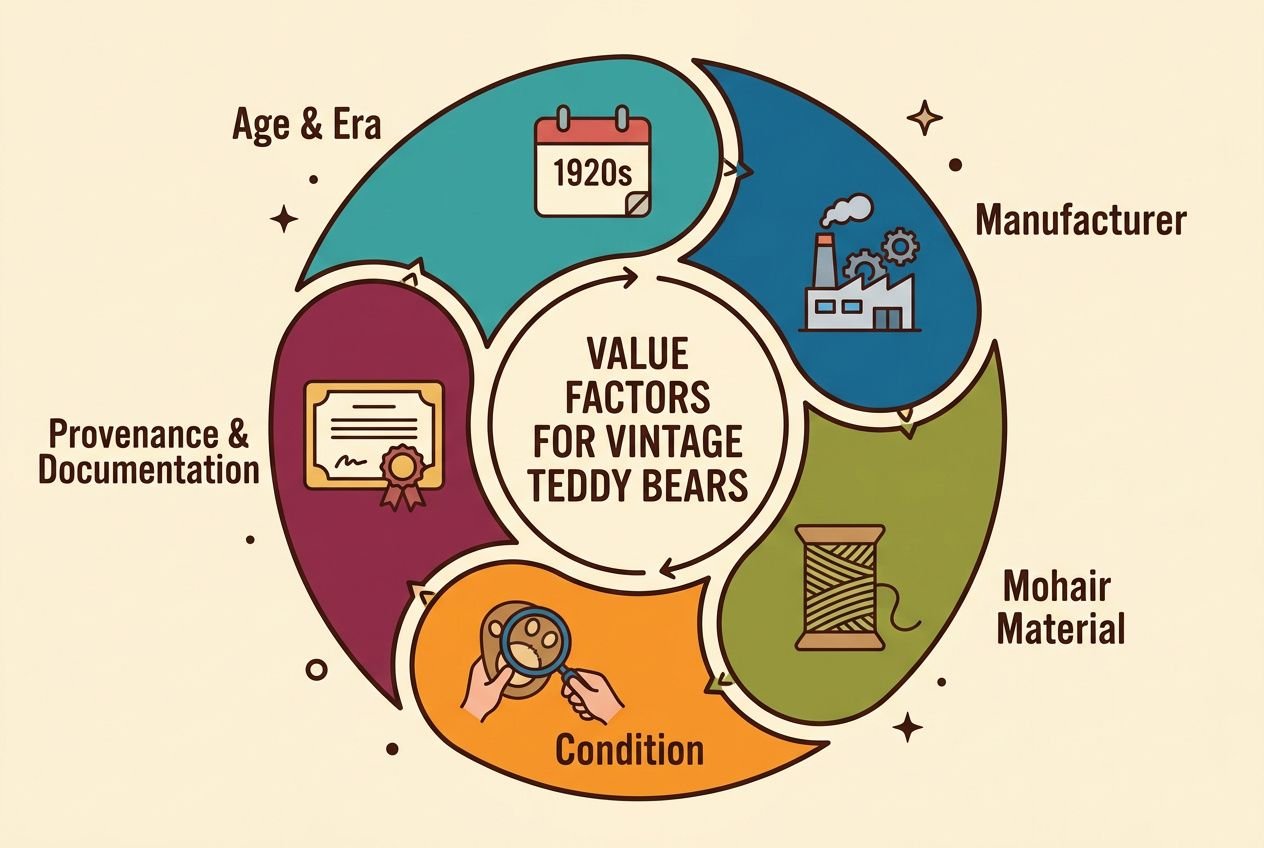
Several factors shape vintage bear value, and no single point gives a reliable answer on its own. Age, maker, materials, condition, originality and provenance all matter; what matters is how those elements come together in a single piece.
Age, rarity and mohair construction as top value factors
Any reliable vintage teddy bear value guide places pre-war production at the top end of the market. An antique teddy bear from the early 1900s by Steiff or Farnell can realise several thousand pounds at a teddy bear auction, while a jointed mohair bear from around 1910 in good condition may reach five figures.
That emphasis on age leads naturally to rarity. Short production runs can double the price of a standard line from the same period, especially when the vintage bear survives with identifying marks and a clear history.
From rarity, material is the next dividing line: mohair remains the premium covering in this field. A mohair bear develops a soft, aged patina that synthetic plush does not reproduce, and collectors consistently reward that character in both an antique bear and a later vintage teddy.
Once material and age are established, the maker becomes crucial. A Steiff teddy bear, along with examples by Schuco and Bing, regularly sits in the strongest price brackets because those names are tied to early design and durable jointed construction.
How condition and original accessories affect the price
That strength in maker and material only goes so far if condition is poor. Bear value falls quickly when there is heavy mohair loss, visible repairs, replaced paw pads or weakened internal structure, and the gap between “worn” and “excellent” can mean hundreds of pounds.
In practice, a vintage teddy bear with age-related wear that has been clearly described will often be judged more favourably than one with undisclosed restoration. The detail that makes the difference here is accurate grading, since transparency protects confidence in both the bear and its history.
Alongside this, original extras carry real weight. Original tags, certificates, ribbons and boxes can lift value substantially: a bear worth 800 eur without original tags may reach 1,200 eur with them, while complete packaging can increase that figure further.
From there, the same pattern appears in period details. An antique teddy with a growler, even a faint one, retains historical interest, and factory clothing adds provenance in a way replacement outfits never can.
| Value factor | Impact on price | Key detail |
| Pre-WWII age | Very high | Early 1900s bears fetch the highest prices; post-1970 bears rarely qualify as an antique teddy bear |
| Mohair fur | High | Mohair bears consistently outprice synthetic equivalents; patina adds desirability |
| Manufacturer (Steiff, Farnell, Schuco) | High | Recognised makers command premiums; lesser-known makers require stronger condition |
| Rarity / limited edition | High | Short production runs can double value versus standard lines |
| Condition grade | Significant | “Excellent” versus “worn” can represent hundreds of pounds difference |
| Original accessories | Moderate to high | Original tags, boxes, certificates strengthen both provenance and price |
| Working mechanisms | Moderate | Growlers and squeeze mechanisms add historical value even when non-functional |
| Jointed construction | Moderate | A jointed bear signals quality manufacture and pre-1960s production |
How to research, document and preserve your teddy bear collection
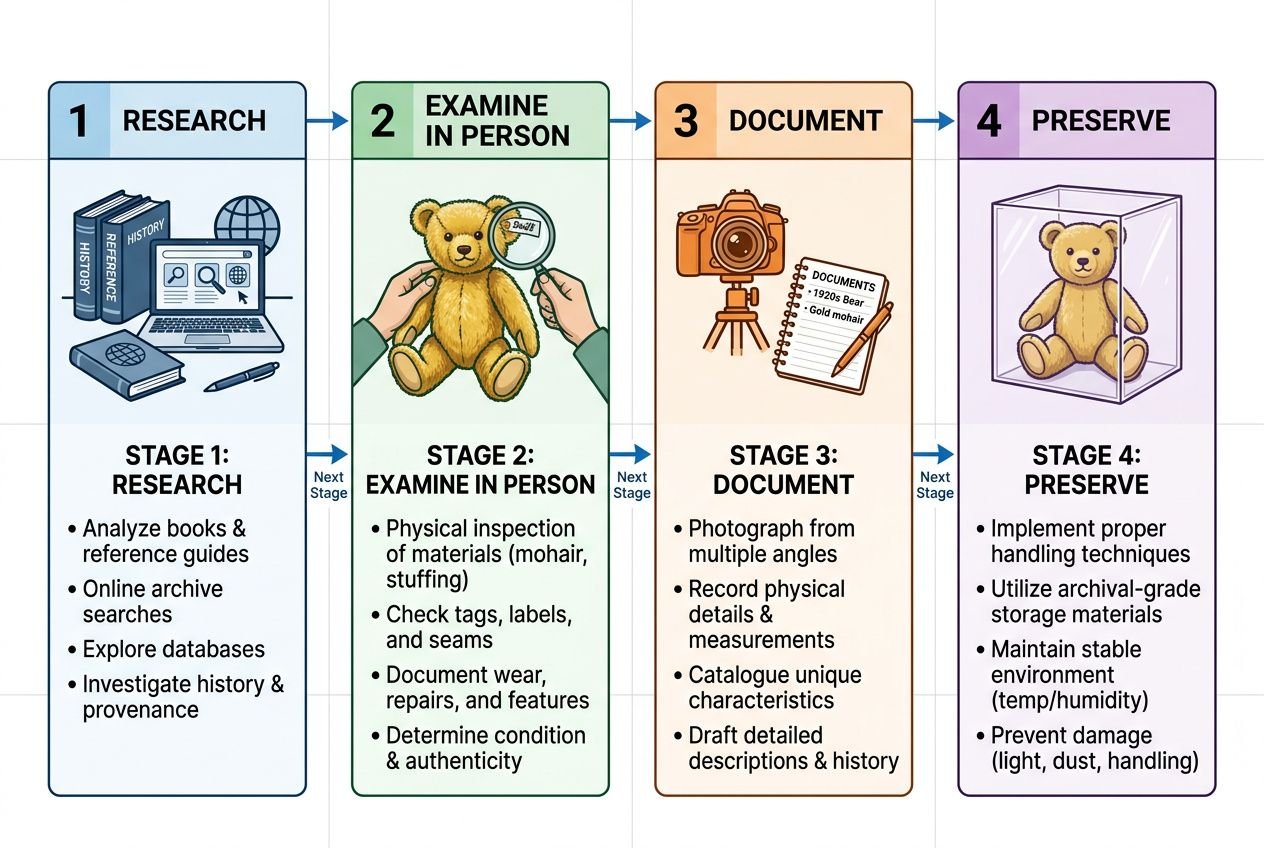
Identifying a bear is only the beginning. To understand an antique teddy bear properly and protect its long-term value, research and documentation need to become part of the routine.
That applies equally to a single vintage teddy bear and to a larger group built over time. Once records are kept consistently, provenance becomes clearer and valuation has a firmer basis.
Building expertise and researching rare old teddy bears
The teddy bear collection value guide starts from a simple idea: accurate judgement comes from reading, comparison, and direct handling. A printed price guide helps, but it never replaces familiarity with real bears from different makers and periods.
Once that foundation is in place, each piece handled adds to a useful mental archive. Subtle differences in fabric, shaping, and construction often become easier to recognise over time.
- Visit specialist fairs and auctions: teddy bear fairs, antique centres, and a teddy bear auction setting allow close comparison between makers and materials. Speaking with a specialist in person sharpens the eye in ways photographs rarely can.
- Browse manufacturer archives online: searching maker names with model numbers can help confirm date and identity, especially when labels are worn or missing. This is often valuable for identification work on an antique teddy or vintage teddy.
- Handle period fabrics: learning the feel of silk plush, sheepskin, and mohair across different decades builds confidence. Genuine mohair is worth looking for when distinguishing an earlier bear from a later synthetic example.
Collectors who collect vintage teddy bears with discipline usually learn faster. Placing a Chad Valley teddy bear beside a Chiltern often reveals shared construction habits from the same era, while differences in muzzle shape, paw treatment, or stuffing can be just as telling.
Alongside this, following teddy bear auction results gives a living price guide based on actual demand. For rare old teddy bears, 1950s examples included, that market evidence can be more useful than relying on old estimates alone.
Documenting your collection to protect its long-term value
Once research habits are established, careful records become the next safeguard. They matter especially for a vintage teddy bear from the 1950s or earlier, where materials and construction can sit between older traditional methods and later synthetic production.
Details such as glass eyes, kapok filling, early plastics, and mohair can affect both dating and value. The right choice depends on whether the aim is insurance, resale, or simply keeping a trustworthy archive of the collection.
- Photography: record each vintage bear from the front and side, then add close-ups of labels, ear buttons, paw pads, repairs, and wear. Clear images support identification and condition reporting.
- Written record: note where and when the bear was acquired, the price paid, maker, estimated date, materials, eye type, stuffing, and any visible restoration. Include original tags if present, as well as any paperwork that strengthens provenance.
- Numbering system: assign every collectible teddy bear a catalogue reference linked to its file. In practice, this makes it much easier to trace history, compare notes, and present the piece clearly to a specialist or insurer.
That becomes particularly useful when checking a price guide, preparing for sale, or consulting the teddy bear collection value guide. A clear catalogue also helps separate confirmed facts from later assumptions, which matters when dating bears with replaced parts or uncertain labels.
Cleaning and preserving vintage bears without losing value
Good documentation naturally leads to careful preservation. Before any cleaning, check the care label, look for electronic components, and inspect seams and pads for weakness.
For most vintage teddy and antique teddy pieces, dry methods remain safest: gentle brushing, low-suction dust removal, and controlled deodorising avoid unnecessary strain on old materials. A practical reference is this stuffed animal cleaning guide, which covers baking-soda treatment, freezing for dust mites, and careful spot-cleaning without a washing machine.
From there, brand and build quality should guide the next step. Modern collectable lines with delicate fabrics may require dry-clean-only handling, and the same principle applies to any vintage teddy bear with fragile stuffing, thinning pads, or a worn mohair surface.
Patch testing is sensible before any localised treatment. Air drying away from direct heat helps preserve shape, finish, and older filling materials, while rough washing can quickly damage a mohair bear or reduce the value of an antique teddy bear beyond repair.
For more advanced assessment, a specialist can help with identification, restoration boundaries, and an informed view of likely value. That is especially useful for an antique teddy bear with uncertain history, a collectible teddy bear headed to auction, or any example being assessed against a current price guide.
Frequently asked questions
How can you tell if a vintage teddy bear is genuinely valuable?
Value begins with careful teddy bear identification. Key signs include a maker's label or ear button, mohair covering, a jointed body with disc-and-pin construction, and glass or boot-button eyes: these features collectively distinguish a genuine vintage piece from a later reproduction.
Once those features are in place, age and maker matter. Pre-war production, a recognised manufacturer, and surviving original tags all strengthen the case, while condition has a direct effect on bear worth.
A worn but uncommon jointed bear may still justify review by a specialist, especially where rarity or provenance adds weight. Collectors will note that original materials and untouched features often support stronger assessments than later repairs or replacements.
What are the most valuable teddy bear types for collectors?
At the top of the collector market, pre-Second World War bears from Steiff, Farnell, Schuco, and Bing remain the names worth looking for when value is the priority. Among established teddy bear types, early 1900s mohair bears with jointed construction tend to attract the strongest prices, and the rarest examples can reach five figures at auction.
From there, 1920s and 1930s pieces are also keenly sought, particularly when labels, working mechanisms, or other period features survive. Artist-made bears form a separate category, alongside numbered limited-edition modern collectibles from makers such as Charlie Bears: the right choice depends on whether interest lies in historic manufacture or later collectable runs.
A short production run, strong provenance, or an unusual variation can lift results far beyond those of a more standard vintage teddy. Once you know the category, those distinctions become far easier to weigh against condition and originality.
How much is a 1950s or 1960s teddy bear worth today?
A 1950s example by a recognised British maker such as Chiltern, Chad Valley, or Merrythought will often fall between 80 eur and 400 eur in good condition, particularly where labels remain in place. Size, mohair quality, and whether the bear is fully jointed all influence the final figure.
Alongside this, stronger results are possible for bears with original accessories or well-documented provenance. By contrast, a 1960s teddy made in synthetic plush with plastic eyes and no maker's mark may be worth less than 30 eur, which is why proper identification matters before any estimate is given.
The late 1950s brought a clear material shift. Checking the fibre type first, mohair or acrylic, keeps the assessment grounded before any other factors are weighed.
Share this article:


